Tuesday, September 06, 2011

Captain Darling's weapon

Anthony Seldon's article in yesterday's Evening Standard was spot on in its analysis of Gordon Brown's strengths and weaknesses, in the news again following the release of Alistair Darling's book.


Darling has told us that Brown had no plan for government after spending years focusing on ousting Tony Blair. Brown was a nightmare to work with at times. Most of the cabinet except Ed Balls wanted Brown to quit but didn't force him out. This much we know. He also reacted to the global financial crisis superbly and led an international response. This much many of us knew and many dispute for political reasons.

Darling's book is interesting because he is such a reserved, measured and careful politician. Anything he says has to be taken seriously. Though there doesn't look to be much revelatory content in his book it does bring the Brown years to live in even more detail. It also gives the Tories a bit more mud to sling at Ed Balls who has again been heavily implicated in much of the negativity attributed to Brown.

Politically Labour still has work to do to establish economic credibility. That Darling and Brown disagreed with be played out as Balls making the wrong call. Balls is big enough to deal wit the blows he now expects to receive. It is going to be interesting to see how this is played out in the polls and whether voters really care about arguments that bother those in the Westminster bubble.


Friday, September 02, 2011

The greatest newspaper in the world

The Daily Express is according to itself. It seems to have moved on from Princess Diana's untimely death and is back to competing with the Daily Mail about scroungers. Today's front page made me chuckle:

I agree that it is scandalous that so many don't have work. What does the Express think we should do about it?  Either this is, as the Express claims, because of a culture of welfare dependency, or perhaps a symptom of post recession rising unemployment. Something that is happening worldwide.

I'm worried about John Cleese too. Has he only just noticed that London is an international city or that it is in Britain?

Thursday, September 01, 2011

A Lib Dem future?

Ed Miliband and many in the Labour Party still feel that an olive branch to disaffected Lib Dems is a path back to redemption. There are votes to be had at the Lib Dem's expense though I doubt these will be sufficient. Recent Guardian/ICM polling shows that Labour and the Tories are neck and neck. Something else needs to give Labour the poll surge it needs to stand a chance at the next election.


Tories on the right will be keen to drive open divisions in the coalition as it still rankles with them that they don't rule alone. 

The Lib Dems claim they are exerting a moderating influence on the Tories. The polls suggest people think otherwise. 

Lord Adonis told Politics.co.uk that he wants Labour and the lefty Lib Dems to be closer aligned. Despite not fitting in with their Orange Book colleagues, these MPs and supporters find it difficult to reconcile their differences with Labour, either because they hold a 1980s grudge or because they feel that Labour in government was too authoritarian. 

I can't envisage any significant shifts in the party political boundaries in the near future. The Tories are keen to show that their tough medicine will help the country in the long term and want to win and govern alone at the next election. The Labour Party needs to be attractive enough to win votes from Tory voters in addition to the demotivated on the left. The Lib Dems are desperately trying to hold their nerve in government in the hope that people thank them in the end. As Rafael Behr points out, Nick Clegg "can't be ignored." Labour and the Tories hope voters think otherwise and that still seems likely.

Wednesday, August 31, 2011

Politics is bankrupt

Labour is £10m in debt and the proposed changes to party political funding threaten its future further. If donations are capped at £50k then the party, so heavily reliant on trade union funding, wouldn't be able to operate.

Blair tried to move away from the union dependency, unsuccessfully. He instead sought funding from wealthy businesses. That ended in tears with the cash for honours "scandal." Rob Marchant highlights that Blair regretted not reforming the party more to put it on a more stable future footing. That opportunity was missed, leaving the party vulnerable to a Tory Lib Dem pincer movement.

The simple reform that would have stopped this becoming a problem of debt and trade union funding would have been state funding of political parties. This was the favoured option of the man who led the most recent investigation into political funding in the UK, Sir Christopher Kelly. Yet his recommendations were deemed unpalatable.

Given that politics is already largely funded by state money in paying for MP's researchers and caseworkers, plus opposition support and civil servants it would be more honest to do this properly and openly. I'm sure most voters don't realise this at all. It is unhelpful that many of these costs are currently described as MPs' expenses, when office costs and those for moat cleaning are quite different.

That the Tories and Lib Dems are even in a position to push through a chance that would have such a one sided impact on party politics shows how wrong the system is. We need something fair and independent of parties that means politicians and favour can't be bought. Yet nobody seems to be making this case.

Politics will become morally and financially bankrupt if this happens. It leaves the door open for a future scandal. That in turn will only put people off politics even more and close the opportunity for the only honest solution available.

Thursday, August 25, 2011

Where is your society Cameron?


Cameron expressed shock and anger at the riots, like us all. Unfortunately he has talked Britain and our sense of community down since. Now that the initial shock should have passed we need to focus on understanding what happened and why. Bringing back the cheap slogan of "Broken Britain" won't help that. 
Tony Blair's response to the riots was right and highlighted where David Cameron has failed to understand British society. Blair highlighted that the reaction to rioting, with mass clean ups and funds to help victims tells us more about our society than the rioters do. 


"Broken Britain" turns a society where community is valued to one where there is no community. Cameron's rhetoric has echoes of Margaret Thatcher's claim that "there is no such thing as society." Perhaps that is because Cameron and his millionaire cabinet colleagues have never lived in an ordinary community.

Cheap jibes at the expense of community from Cameron doesn't surprise me as he is a Thatcherite to the core but it goes against the compassionate Conservatism language he used a couple of years ago. This shows that to be acting and that he has now reverted to type. 

What British society needs is a reaffirmation of community. Talking it down, denigrating the sense of togetherness that most people feel about where they live won't make things better. If we all bar our windows and stay at home every night for fear of a feral youth attacking us there will be no point in living in any of our cities.

If Cameron wants to lead he needs to show that he has moved on from the opportunist rhetoric of opposition drawn up by Andy Coulson and start to show he has a positive vision of the country. Panic and derision will only lead us into the gutter. 


Bigot bandwagon goes on

Setting up a news search for racist comments by Tory councillors is throwing up a conveyor belt of examples. The latest to join the club is Brighton councillor Lynda Hyde. She has been forced to apologise for emailing "offensive" "jokes." When will they learn?

Tuesday, August 23, 2011

Does a social site extend your campaign reach?

To much comment among the Labour twitterati Ken Livingstone yesterday launched his social campaigning site Your Ken. Building on the social media success of Barack Obama's 2008 campaign has been the holy grail of political campaigning everywhere else since. does Your Ken do the trick?

Other attempts to create new political social networking sites have failed because they haven't been better than Facebook or Twitter. They also failed because people didn't follow and use the sites. That led to sites such as Labour's Members Net being little more than empty shells. In attempting to draw younger members together through social networks local groups have preferred to create their own Facebook groups or to create a sense of belonging through Twitter hashtags, such as #labourdoorstep.

Whether Your Ken becomes another empty shell or not depends on whether there is enough reason for people to dwell on the site. Will there be enough exclusive content? Will activists be able to interact in a way that they are not able to elsewhere? Will activists want to compete for the prize of the leading activist?

Even if all that happens what may not happen is that Your Ken opens up his campaign to anyone who wasn't already interested. If the site can enthuse new activists and get more out of existing activists it will have been a success.

Gaining the London mayoralty might not be the same status as President of the United States but to a Labour supported denied power nationally it would be a great start.

Friday, August 19, 2011

Tory conveyor belt of bigotry rolls on

Yesterday's Tory news of the Dover councillor who dubbed rioters "jungle bunnies" has now apologised though still hasn't shown that he understands why his remarks are so offensive. Unfortunately today sees more Tories showing how out of touch they are with the modern world:

Tory tweeter @londonistar shows a startling mistrust for women in politics. I wonder what she thinks about Margaret Thatcher?

Thursday, August 18, 2011

Conveyor belt of bigotry

A few times a year a Tory somewhere comes out with something racist. The latest on the conveyor belt of bigotry is 49 year old Dover councillor Bob Frost. He referred to rioters as "jungle bunnies" on Facebook.


Nasty man. 

He responded to the accusations:

"'Looking at the dictionary it would appear that the term jungle bunnies is perjorative [sic] and is a racist slur relating to African-Americans. Needless to say I did not mean to use any offensive racist term and was referring to the urban jungle."

His faux naivety would be endearing if his comments were not so despicable and offensive. His non apology just twists his bigoted knife further. 

How does Cameron's "compassionate Conservatives" continue to allow this type to represent them in the first place? 

Wednesday, August 17, 2011

Political blog awards

It is that time of year when you get to vote in the Total Politics blog awards. I'd love it, just love it, if you voted for me.


Click here to vote in the Total Politics Blog Awards 2011

Tuesday, August 16, 2011

Phone hacking: a story

A tabloid newspaper journalist walks into his Monday morning editorial meeting.
He editor asks him what stories he is running that week.
He says he has an exclusive that a famous person is having an affair.
The editor says great, lets run that on our Sunday front page.
"One thing" he says to the journalist, "is our evidence reliable? I don't want us to get sued."
"That's OK" replies the journalist, "we've got recorded evidence of the two people discussing the affair."
"How did you get that?" asks the editor.
"From their mobile phones" says the journalist.
"Oh" says the editor, realising that phone tapping or hacking is illegal. "Lets run the story anyway and never discuss this again. Good work."

It couldn't happen could it? An editor would never sanction that for the sake of an exclusive would they?

Clive Goodman's letter confirming that the editors of the News of the World knew about phone hacking should be no surprise. Andy Coulson knew, so I'm sure did Rebbekah Wade and James Murdoch.

The cuts in this story get deeper, making it even more absurd that David Cameron still felt it OK to employ Coulson even though he knew this had happened on his watch. The more this story goes on, the more the wagging finger wags at Cameron.

Cameron thought News International support was more important than keeping his office clean, so he overrode any concerns. This was naive and he will continue to suffer for it.

Thursday, August 11, 2011

Tough on crime, tough on the causes of crime

Tony Blair's words of 1993 are as prophetic as ever in setting out what we do as a society to tackle this huge problem of urban unrest. We need to come down on rioters and looters hard. People don't want that and those involved need to know that there is no place for that behaviour.

People will speculate about the causes of the riots. Nobody will ever agree. A poverty of ambition and aspiration among the criminal rioters seems prevalent. This comes despite many years of additional education funding and opportunity. That obviously wasn't enough. Taking away much of that, as the Tories have done and are doing, won't help. It explains but doesn't excuse.

Today's parliamentary debate saw some agreement between David Cameron and Ed Miliband. That is promising. If this tragedy is turned into a political game of ping pong nothing will get done. A lot needs to get done.

It would send out the wrong signal to cut police numbers and budgets now. It did anyway but eve more so now. Otherwise how will the authorities react in future if something like this happens again? Cameron still wants to cut budgets which threatens to roll back the progress made over recent years to reduce crime and make our streets safer. In London I've personally felt the benefit from Safer Neighbourhood Teams. Cuts to those in this context will show that the Tories really just don't get it and don't have the backs of ordinary Londoners covered.

The key challenge is to ensure that the right words now don't filter away as they did in the 1980s and in the USA after Hurricane Katrina. We need to show that we've learnt from that. Cameron needs to show that Conservatism really is compassionate and that it won't just be tough on crime, but also its causes. This means that budget cuts should never take precedence, as they seem to be, over public safety or rebuilding our communities.

Cameron isn't Blair yet and never will be.


Tuesday, August 09, 2011

Cameron as Jim Callaghan

Now that the leading Tories are all heading back to the UK with their tails between their legs serious questions had I be asked as to why it took them so long. With serious unrest breaking out over London and other cities over the weekend it was clear that politicians needed to take charge. 

People need their leaders to take their problems seriously and show they care. The Tories failed to show that leadership and that they've belatedly woken up to the scale of the rioting crisis begs big questions. 

Why has it taken them so long? Did they really care? Their PR advice if they had any has been woeful. It reminds me of former PM Jim Callaghan returning from holiday during the 1978 winter of discontent and being dubbed 'Sunny Jim' while also being derided for playing down the crisis. He was misquoted as saying 'crisis, what crisis?' the mud stuck. 

Reacting slowly to the hacking crisis and now rioting, Cameron needs to be careful. That man who had his finger on the nation's political pulse and reacted quickly to the MP expenses scandal has gone AWOL. Cameron needs to find that skill again and sort out this mess. 


- Posted using BlogPress from my iPhone

Friday, July 22, 2011

Hacking: what did they know?

If the Murdochs thought their appearance before the parliamentary culture committee would have sated those waiting for their blood, they are wring. Today's revelations that James Murdoch knew about the payments to Gordon Taylor when he claimed otherwise is likely only the start of an unravelling of their defence.


What Rupert Murdoch, James Murdoch and Rebekah Brooks said they knew abut hacking in public seems flimsy. What David Cameron knew about what Andy Coulson knew also isn't clear and poses questions about why the then prospective PM was so desperate to employ the ex- News of the World man when it was clear there were doubts about his suitability.


The Tories have tried to divert attention to Labour and Ed Miliband's press chief Tom Baldwin. There is no evidence that The Times acted improperly, or that Baldwin did. That he worked at a News International title isn't enough to sling mud. It is quite different to Andy Coulson who had already been forced to resign from his editorship of the News of the World because of phone hacking. The Tory attacks on Baldwin smack of desperation.


The questions about the Murdochs will continue and so will those to Cameron. Why wasn't Coulson properly vetted? Again, the suspicion that Cameron knew more than he is letting on still smoulders. Hacking has damaged Cameron's credibility permanently and has awakened Miliband from his slumber. The political sparring between the two should be different now. The Telegraph is no longer unconditionally supportive of Cameron. 


While it is clear that those at the top of News International, the police and government probably knew more about this than they have let on, who ends up paying the ultimate price for hacking is unclear. The police have paid a heavy price and that will only get worse as the investigation into bribes uncovers more corruption. The price for Cameron hasn't been set.


Cameron can only hope that what he gained in employing Coulson, the support of News International and a helping hand into government, is worth what he could lose when eventually the dirty laundry has all been aired in public. 

Tuesday, July 19, 2011

Cameron and Coulson: no smoke without fire?

As I wrote yesterday, if the top brass of the Metropolitan Police have resigned because of the "smoke" caused by association with News International staff, why is David Cameron excluded from this charge? Surely his association with Andy Coulson is worse than the police association with Neil Wallis? At the very least it requires the same level of scrutiny.

So far Cameron has rejected criticism that he could have avoided bringing himself and the centre of government into this scandal by not employing Coulson. When he employed Coulson he had already quit his job as News of the World editor following the jailing of Glenn Mulcaire and Clive Goodman for phone hacking in 2007. The Met Police can claim ignorance of Wallis' involvement as at that stage he hadn't been implicated, but they did the right thing and quit anyway after facing growing doubts about their impartiality.  

Given Paul Stephenson and Andy Yates' resignations the focus will inevitbalby shift closer to Cameron. At some point he is going to have to open himself up to scrutiny and answer these questions. I suspect that he was so in thrall with the power of News International when in opposition that he thought the benefit of employing Coulson outweighed the risk. 

The Sun's support for the Tories was much publicised in late 2009
The Tories had been out of power for (eventually) 13 years and were desperate to get back in. News International support was obviously deemed critical to that. The Sun's switch to the Tories after Gordon Brown's last conference speech was the denouement of that relationship. Pat McFadden at Progress gives a good account of how Labour had courted the same support in the 1990s, then seen as critical to gaining power.

Cameron got himself into power but at what price?

His traditional media support base at The Daily Telegraph is no longer supporting him. Their editorial today states: 

"Mr Cameron wants to draw a distinction between, on the one hand, his relationship with Mrs Brooks and Mr Coulson, and on the other, the police's relationship with Mr Wallis. But this simply won't wash."

The New Statesman points out that Cameron "cannot afford to keep up his silence much longer". The drip, drip, drip of accusations will continue until Cameron puts them to bed. Nothing else is going to make them go away, only he can do that and should have put out the flames of innuendo quickly. By now he could have been in the recovery phase but instead he remains vulnerable and the "smoke" wafts around him as he continues to fan the flames.

Monday, July 18, 2011

The hacking web widens

David Cameron continues to be incredibly vulnerable on phone hacking. I still don't understand why he felt it necessary to appoint Andy Coulson after he'd been forced to quit the News of the World about hacking, well before we even knew the full extend of the nasty practice.

Cameron has still refused to cede ground that employing Coulson was a mistake. Some of the victims in the hacking scandal we may find to be unfortunate to have been implicated by association. Cameron had the choice whether to involve himself in this or not and chose to do so.

The problem is that the police have taken illegal bribes from corrupt newspapers. The prime minister has involved himself by association unnecessarily. As the resignations build up the focus shifts to others. The top of the police have gone and parts of News International are crumbling.

I having continued to meet with Coulson and to defend his appointment I can't see Cameron backing down now. All that does is ensure that an ever growing amount of mud will stick to him over hacking. When it didn't need to.

As the web widens the focus will shift to James Murdoch and Cameron. There will be so many more revelations before proper investigations even begin.

Thursday, July 14, 2011

Brown bites back, Cameron retreats

An initial Parliamentary love in yesterday when all sides agreed to investigation and inquiries became partisan as dirty politics reared it's head again. Former PM Gordon Brown hit back at critics who claimed he should have done more when in power to investigate hacking.

Brown's searing attack on News International showed he feels emotion about what happened politically and to his family. Fair enough too. The speech showed that there is more to him than many people gave him credit for when PM. That he took the civil service advice not to investigate further perhaps shows that he wasn't always the decisive PM who would take a decision whatever anyone else said. We knew that anyway, but what is different is seeing a former leader show "regret" for something like this so quickly afterwards. They never do this. Can you imagine Blair or Thatcher doing the same?

Ed Miliband's requests for inquiries and investigations, together with the end of Murdoch's bid to buy back more of Sky have all been heeded. He has had a good couple of weeks.

David Cameron has accepted what has been thrown at him. Except when it involves Andy Coulson. He is still vulnerable here. He will continue to be so until the election as investigations and inquiries are going to take years to uncover what happened. The drip, drip, drip is likely to weaken and infuriate him as Labour and the rest of the media continue to question his judgement.

This is all Cameron's fault though as whether he knew what Coulson had really been up to he knew it was an avoidable risk in employing him and chose to take it. The price is getting dearer by the day.

Tuesday, July 12, 2011

Will Miliband pay for his attacks on Murdoch?

He is playing a dangerous game, one that put paid to Neil Kinnock's chances of being PM almost 20 years ago. If Murdoch is fundamentally weakened then Miliband will get away with it. If his power remains he could find himself up against an insurmountable barrier of opposition from Murdoch.

Even before hackgate really kicked off in the last few weeks, is the Murdoch media empire as powerful as it once was? Politicians clearly think so. Given that Murdoch will continue to control a significant level of British media, across the newspaper titles, Sky News and BSkyB. He still matters whether we like it or not. Many of the British public might not like the hacking of murder victims' phones or the Queen's private details but I don't expect them to stop buying Murdoch products.

Miliband has grown during this crisis. He has been saying the right things and doing so with more gravitas. The media has also been keen to give him prominence. It is going to be interesting to see whether this translates into improved personal poll ratings for him as this impact has been lacking so far.

Miliband's future success depends largely on how strongly the government come down on media owners. Their presumption is to step away, which is being challenged by recent events. If the Tories revert to type as the brouhaha dies down it will strengthen their own position by strengthening Murdoch and knocking Miliband.

These are interesting times in British politics. The goalposts are shifting every time I look at the news. Will they shift enough to force the Tories to limit the size of a media market owned by one person? I'm not sure they will, which puts Miliband in a vulnerable position.

None of this will be worked out for some time. There are clearly more revelations to come, especially about how much David Cameron knew about Andy Coulson's involvement, about severe corruption in the police and about more people who were compromised by News International. Enquiries and police investigations will all take time too. Projecting forward I would not be surprised if this was still rumbling on in two years time or more . Just as we head towards another general election.

Will anybody care then who The Sun backs? Cameron will, Miliband has already shown he doesn't.

Friday, July 08, 2011

Cameron and Coulson: ticking time bomb

Peter Oborne has speculated this could be Cameron's black Wednesday. This story has a lot of legs left and will run. The longer it does the more Cameron's credibility will be damaged. Cameron has said that he is responsible personally for bringing Coulson into the centre of politics, therefore he has to take the blame.

Cameron won't quit so instead this issue will continue to be a distraction as Labour should continue to bring it up time and again. To paraphrase Oborne, this mud has stuck to Cameron and won't go away. Ever.

With friends like these... David Cameron’s judgment is under question (Photo: Dafydd Jones)

Thinking about hacking, my suspicion is that the police didn't open up or expose the full scale of the scandal because they had a vested interest in keeping it quiet. The focus to date has been on the newspaper and not on the police. I'm more worried about the police being corrupt than I am about journalists. The police are meant to be whiter than white as public guardians but have taken serious sums in bribes.

There is trouble ahead for the police and for David Cameron. I suspect he won't be able to safely defuse the ticking bomb.

Wednesday, July 06, 2011

Hacking: implications for Cameron

The ever more sickening News International phone hacking scandal is bringing several media regulatory and political issues to a head.

The government says it wants to reduce media regulation by abolishing or drastically cutting back Ofcom but at the same time is planning a raft of additional rules for advertising. This inconsistency shows that the government hasn't thought its proposals through, like much of the plans they have rowed back on in the face of opposition. Critically, can we really afford to cut back on regulation further when the phone hacking scandal shows us that self regulation of the press has failed so spectacularly?

The LSE's Damian Tambini suggests we need to go further. Many people will now agree. The only way big media owners follow is if there is insurmountable political and public pressure on them to accept this.

Labour can ratchet up the pressure on the Tories to announce a full public enquiry out of which a more robust regulatory regime needs to emergy. Labour has little to lose in attacking what has happened because it has almost no support at News International at present. I'd love to hear what Ed Miliband's press chief Tom Baldwain, ex of The Times, has to say about this. At the moment there is no evidence to suggest that hacking was happening organisation wide, rather than just at one NI title.

Six months ago when Andy Coulson quit, after a sustained drip feed of suggestins that he knew more than he admitted to about this, serious questions have been raised about David Cameron's judgement in appointing the News of the World's former editor.

If a journalist comes to the editor of a newspaper with a new, exclusive story the first question their boss will ask is "what is your evidence?" I can't believe that Coulson and Rebekah Brooks didn't know about this. How else will they have been able to explain the source of exclusive after exclusive to their legal team?

If we assume they did know then Cameron should have been aware too. He must have done some sort of due diligence on Coulson before appointing him and should have been aware that doing so opened him up to risks of association. If he didn't do his research, why not? Either way, his judgement has been shown to be poor.

I suspect Cameron was too desperate to gain a poll lead to worry about this. It is unlikely he was aware how sickeningly deep this scandal actually went. Coulson's tabloid friendly leadership helped to get the Tories into power, even though it wasn't enough to win them the election.

Cameron is deeply implicated in this. He can wriggle his way out by announcing a full public enquiry and putting a stop to a culture of self regulation, collusion and acceptance of dreadful malpractice.He might not because to do so would mean an admittance of the scale of the problem, that he is himself implicated in.

Tuesday, June 21, 2011

Mandelson meddling again?

Peter Mandelson's speech to Progress yesterday was a predictable, right and honest appraisal of the Labour Party's current predicament.

It isn't news that Labour needs to make a bigger impact on voters after a natural period of reflection following defeat a year ago. It isn't news that Labour is skint either, but how exactly the party is going to fund itself is a rather large, unaswered question. At the moment the reliance on trade union funding is stark and quite worrying. A return to the days of big business donations is also unlikely as a party of opposition is far less attractive a proposition.

His lesson is that what Labour learnt in the 1980s and 1990s - that it must focus on appealing to voters first and last is as true today. That is why the real lesson of New Labour, which is about having an honest centre left appeal to people that is based on an understanding of what people actually want, stands as true today as it did in 1994.

Personalities may change but the principle should remain exactly the same. 

Changes do need to be made to the wording. Party structure and policies need to change to reflect that we are not in 1994, 1997 or 2005 any more. The game has changed and will have done so further after at least five years of Tory destruction. The relationship between state and individual will be completely different in 2015 to the one Labour left behind.

As Ed Miliband said in one of his first speeches as leader, we need to be the optimists. Labour need to show the country that we can improve public services and offer better value for money. We also need to stand up for services that improve people's lives, protect the environment, enhance opportunity and create opportunities for business. The Tories are pessimists who don't believe it is even worth trying to achieve many of these goals. Labour needs to show that things can be different.

Mandelson's speech demonstrates there is a lot of work to be done to get Labour into a winning position again. He also shows that by sticking to the principles that made the party so successful not that long ago, it doesn't have to be that difficult.

Friday, June 17, 2011

A poor week for all the parties

It is popular to remark that the Tories are undergoing a series of policy and political retreats. It is also popular to opine that this is a result of the Lib Dems restreating to their lefty safe territory after their local election wipe out.

Some of this is true. We wouldn't have had the NHS reform listening exercise or the changes to the programme if there wasn't something different about it. The real difference isn't in the policy changes that may or may not happen, I expect wholesale changes to the NHS to happen anyway.

What this all demonstrates is that the Tories feel politically weak. They are allowing both the Lib Dems and the risk of unpopularity with the electorate to force their hand. The Tories should feel stronger than they do because even if the Lib Dems want to flex their muscles, they too are week and facing oblivion.

The Tories know that the NHS is an historic weakness. People don't trust them with it so they can't take the risk losing whatever credibility they have with the health service. This also demonstrates political naiivity. Properly researched and planned before being announced, these changes could have met the needs of the health service in the first place and avoided talk of u-turns and retreats. This suggests that in the quest for taking power the coalition partners didn't work their way through all the detail. If the Lib Dems really were so opposed to all of this why didn't they say so when they had real power - at the coalition negoatiation phase.

This will be presented as a Lib Dem victory. The danger is that this will appeal to some of the Lib Dems lost voters but will further antagonise their coalition partners and masters, the Tories.

Nick Clegg needs to be very careful, while Cameron has more political strength than he realises. Ed Miliband should do everything to exploit a Clegg clinging on for life and a Cameron who is weak and reactiving the poltical environment rather than shaping it.

Monday, June 13, 2011

Where now for Ed?


It is too early to properly judge Ed Miliband’s leadership of the Labour Party after only eight months. He still has time to prove his doubters wrong because there won’t be another general election for four years. Unfortunately the minds of many in the party and media have already been made up. Ed was on the back foot from the moment he was elected. First he had to defend himself from the “Red Ed” tags and has since been fending off a succession of polls that show he hasn’t yet convinced voters to back him.

Given that he hasn’t made the most convincing start but still has time, how can Ed show people he really is leadership material? He needs to have a plan for the country and needs to communicate that. His vision must be clear and show that he understands that the country doesn’t want a lurch to the left but does want Labour to offer them protection against the rising cost of living and understands their concerns about crime and immigration. 

The plan needs to come quickly to enable Ed to gain positive momentum in time for party conference in September. He has to convince a sceptical party he can get them back into government. Will he? I hope so, though that depends on whether he gives himself the chance. 

Thursday, June 09, 2011

Does the Archbishop of Canterbury really matter?

There has been a lot of brouhaha about the Archbishop of Canterbury's political comments today. It has been the leading story on most news sites. Does this mean anything and does it show that the Church of England is still important socially and politically?

I don't think it does. I think the level of news space given to Rowan Williams' comments owes everything to the media desire to open up a political debate rather than the status of the church. Clearly the church has some status, otherwise Williams' comments would have passed us all by and they didn't.
Williams' comments have held the government to account to some extent. First Vince Cable and now David Cameron have defended their government's record.

I remember the then Archbishop of Canterbury Robert Runcie criticising Margaret Thatcher’s (lack of ) social policy in the late 1980s. Then as now it will do nothing unless the attack resonates with enough ordinary people to create political change. If the church really had status it could do that. As much as I agree with Williams, I don't expect that to happen.

The church getting involved in politics reminds me of Prince Charles commenting on modern architecture. It triggers a debate but a few days later everyone settles down again and forgets all about it.

Wednesday, June 08, 2011

Can Ed Miliband succeed where Tony Blair failed?

The Labour Party has surveyed voters' views as part of the major policy review. This has shown that voters want Labour to be strong on immigration, protect British interests first in Europe and international affairs, propose welfare reform and be tough on crime. This sounds remarkably like Tony Blair's rights and responsibilities policy agenda. It should surprise nobody.


This is no surprise because the country moved to the right at the last election. These are issues that are typically hard for Labour to campaign on as the party finds it easier to talk about subjects that matter to lefties. These leftie issues are unlikely to be enough to win Labour an election. However, these are the bread and butter working class issues and Ed Miliband needs to seize control of this agenda.
The Labour survey also showed that voters want the party to be tough on bankers and to soften the market. This is Miliband's natural territory. I don't think he'll find it easy to be talking about crime and immigration but it is an absolute must. That he hasn't yet can in part explain Labour's failure to secure first place in the English local elections.
Miliband's challenge is the tough, classic one faced by all Labour leaders. Talk tough on crime and immigration and lose support of the party and win votes, or do the opposite. If he can find a happy equilibrium he will strike gold.

Tuesday, June 07, 2011

NHS reform will press ahead

After being criticised by GPs, doctors, nurses, trade unions, the lap-dog Lib-Dems and Labour, David Cameron today unveiled sweeping changes to NHS reforms. Is this a significant political moment as it shows that the coalition isn't quite steaming ahead with its agenda as it would have liked?

I'm not sure the changes are as big as Cameron makes out. The fundamental changes to the NHS will still happen, even if a bit later than planned. GPs will still take over the commissioning of services from primary care trusts. Greater competition will still take place with private sector providers. I accept that the plans have been watered down but the fundamentals remain.
The reform process is ill thought out and suggests a dogmatic wish to return to the John Major days of GP fund-holding. I don't really understand on what basis the Tories decided that GP commissioning would be the answer to the NHS ills. There is no reason at all for this form of service delivery to be more efficient. On the contrary, spending swathes of scarce cash on a major reorganisation at a time when funds are so scarce seems completely foolhardy. For a Tory party that is so bent on cutting public spending to do this now shows how committed they are to the changes and demonstrates an ideological commitment to them.
The delays and changes show how hard Cameron is finding it to run his party and get his legislation through. I expect him to overcome these obstacles and press ahead with an unnecessary and costly reorganisation of the NHS just when it needed it least.

Wednesday, June 01, 2011

What has Boris Johnson actually achieved?

Mayor Boris Johnson is in campaign mode and is wasting no time in telling us all about his achievements. Unfortunately his "achievements" are not that at all, as has been widely pointed out.

BJ is claiming credit for Crossrail, the tube upgrade and obviously the cycle hire scheme. All of these schemes were under way well before his election in 2008. He also claims credit for the Olympic park, again something that has been finished while he has been in power but was secured by the previous mayor, Ken Livingstone.

As the race for London (mayor) 2012 hots up I wonder how many more half truths BJ will be peddling? Quite why he tries to cling on to power so hard when he does nothing with it is beyond me. It all seems quite pointless, much like his mayoralty.

Sunday, May 29, 2011

Party funding debate has be impartial

After last week's revealing of the party accounts showed Labour falling back on it's trade union partners and the Tories on wealthy individuals for support, today's newspapers report again that the Tories want to put a £50,000 cap on donations.

The Tories and Lib Dems claim such a move would remove big money from politics. It would also rip the historic heart out of the Labour Party. The party was formed from trade unions and ordinary working people have a say in the party as affiliated members. Taking that away would create an artificial imbalance in UK politics. I can't believe that the independent Committee on Standards in Public Life will settle for this.

Unfortunately I don't expect the committee to recommend the only radical change that would stop cash for favours on all sides, state funding.

The Tories always paint the union link to Labour as some sort of sinister connection. The union link makes Labour more democratic and representative of more ordinary people than the other UK parties.


- Posted using BlogPress from my iPhone

Thursday, May 26, 2011

The state of political party finances

This morning's newspapers were full of reports of who was funding our political parties. Labour, £10m in debt, is even more reliant on trade union funding than before. The Tories have continued to rely on wealthy businessmen. The Lib Dems didn't have that much at all.

I also read that Tory super-doner Lord Ashcroft has just been given responsibility for reviewing Britain's considerable military presence in Cyprus. The Lib Dems are not happy about that. Ashcroft has bought his influence.

That these two stories appeared on the same day further stoked the strong but little heard argument for state funding of political parties in the UK. While big business or trade unions bankroll politics there will always be the accusation that they buy influence. Cash for questions, cash for honours, Ashcroft. The list of suspicious political funding has a long history and won't stop any time soon.

The only argument I hear against state funding is that voters who don't like politicians will like paying for them even less. That doesn't wash. Voters hate dirty politics and if paying a small amount to fund political parties and election campaigns cleans it up, then it is a price worth paying.

Wednesday, May 25, 2011

Finding the Tory switchers

I wrote yesterday of how Labour needs to target Tory voters to stand any chance of winning power again. The reduction in the number of MPs will only strengthen the need to focus on this. It is only by winning seats from Tories that Labour will stand a chance.

As much as I and many others have revelled in the pitiful state of the Lib Dems, the real enemy has always been their Tory masters.

Caroline Flint wrote for Progress that  Labour has "to reach out beyond our traditional heartlands" to create a real progressive majority. She points out that of the top 100 Labour target seats, 83 are currently Tory. Appealing to these Tory voters has to be the central plank of Labour policy and communications in the next couple of years. Looking at the recent English local election results it is clear that the party is not reaching these people currently.


Ed Miliband will have to blend to aspects as he attempts to drive Labour forward. They are often viewed as mutually exclusive, but I don't agree. Renewing the left of Britain and making Labour a party that rewards talent, is at the centre of our communities, campaigns (and doesn't just talk in dull meetings) can sit hand in hand with appealing to England's centre ground - being aspirational, fair on immigration and winning the economic argument back from the Tories.


Re-founding Labour is a good start but won't be enough as the party has to revitalise without and within.

Tuesday, May 24, 2011

Miliband to woo Tories?

I always find it interesting when someone suggests that the cure to all of the Labour Party's ills is to copy what Tony Blair did. This interests me because I generally agree but also because doing that is so difficult when finding a leader as talented as he is very difficult.

Aping Blair's style might not be right almost twenty years later but Dan Hodges is right that we would do well to heed political lessons from him. Quite simply people who vote Tory need to vote Labour instead. Wealthy people and those in the south. Picking up votes from disgruntled lefties will be insufficient and likely to end in a William Hague-esque core vote strategy. This is even more important if Labour can't win in Wales and Scotland, traditional suppliers of swathes of Labour MPs in Westminster.

How is this going to happen? Labour needs to be realistic about how it plans to win and smell the coffee. That will tell them that it needs to win in England and it needs to win over Tories, otherwise it is curtains.

Monday, May 16, 2011

The NHS:The end of the public service ethos


The point of the NHS is that it is free at the point of use. Nobody is expected to pay directly for their healthcare, it is paid out of central taxation. Another central principle is that the NHS doesn't exist for profit. What we pay in taxes shouldn't be creamed off to pay dividends instead of patient care. This is the pubic service ethos. The Tories plans for the NHS eat away at this.

Today's reports that one of David Cameron's aides Mark Britnell would be a "big opportunity" for the private sector show that the government's (not publicly stated) aim is to chip away at the public service ethos in the NHS. It strikes me that the point in these reforms is to allow the private sector a greater role in NHS service provision. This makes it likely that the private sector will cream off the profitable parts and leave the state to pick up and pay for the rest. Chipping away at the public service ethos is also likely to chip away at the quality of care given to patients as the profit motive encourages the cutting of corners.

Politicallly Britnell's comments demonstrate an extreme naivety about how people feel about the NHS. It also suggests that Cameron's proclaimed "love" for the NHS isn't the same love shared by the rest of the country. Cameron's advisor's comments were not off guard, off the record or mis-quoted. They show what the Tories really want to do to the NHS. They want to part privatise it.

The "pause" in the NHS reforms were just that. Nothing will change, the same reforms will happen, just a little later. Politically the result will be the same. As the Mirror reports that 62% of people are against the reforms, added to all of the professional bodies, this is yet another unpopular and unnecessary Tory policy. How will the Lib Dems react? They won't be able to stop it no matter how vociferous their complaints. Cameron is ploughing on regardless.

At least today's comments showed the Tories' true intentions, nobody can say they didn't realise what they were planning to do when the NHS gets sold off.

Thursday, May 12, 2011

A year in Condemnation


The Liberal Demolition shows no sign of letting up. First there were the glory day(s) in the Rose garden at number ten. Then the betrayals, then the bickering, then the elections.

While repeated blows have landed on the Lib Dems and while they have been serious the victim is more likely to suffer a slow and drawn out death than a knock out punch. The Lib Dems will last to 2015 because whatever happens between now and the next election, like John Major's rebel turkeys, his disgruntled party can't risk a general election that would see them wiped out.

After founding of the coalition David Laws did his best to show that this wasn't "Cleggameron's" new politics as he thieved the taxpayer for several years for rent he didn't have to pay. That Clegg placed the his party's integrity at the behest of what he would have known would be a very unpopular Tory government shows how much he wanted to give his party their raison d'etre: electoral reform. He gambled everything for this. He lost. What has he got left? He has his party to save.


How can Clegg do this? Strong words in public but capitulations in private letting the Tories get their way will only weaken their cause. The real test is whether they can stem the Tory zeal for deep public spending cuts, especially as economic indicators worsen in the coming 12 months.

There is little Cameron will want to do to change the coalition. His government retains control of policy, the top jobs and the blame for anything bad always sits with the Lib Dems. After the initial disappointment of failing to get a majority at the general election a year ago, things could hardly be better for Cameron and his Tories.

Tuesday, May 10, 2011

Boris Johnson = trash

I find it somewhat odd that mayor Boris Johnson today praised the Transport for London management for negotiating an end to next week's planned tube strikes with the RMT.

Remember that this is the mayor which I liken to a boxer before a big bout. Great on the trash talk. Unfortunately for London, he failed to deliver on this. Remember that this is the mayor that promised to end strikes on the tube and has since been too politically pig headed to hold even a single meeting with any of the tube unions. Responsible governing means he should have done this, despite his political hatred of all the RMT stand for.

Today's statement from Johnson was just another load of trash from a mayor who has achieved nothing for London. He deserves to be knocked out in 2012.


- Posted using BlogPress from my iPhone

Thursday, April 28, 2011

Three Tory graphs

After yesterday's disappointing growth figures that showed the economy hasn't grown at all in the last six months, opinion polls continue to show Labour in the lead and strong disapproval for the government's work.

Osborne Effect
Courtesy of Mark Ferguson at Labour List

Government Approval

Tuesday, April 26, 2011

AV rows rumble on and I swing

Differences of opinion between the Tories and Lib Dems about AV continue to attract press attention. What was meant to be an apolitical issue has been fashioned into a party political affair. Peter Mandelson has suggested that Labour supporters should vote yes to hinder the Tories' potential electoral dominance. The no campaign have used Nick Clegg's unpopularity to encourage Labour supporters to vote no.

The recent sniping between the Lib Dems and Tories, plus interventions from Labour's heavyweights has added a little oomph to a rather dull and dry referendum campaign that will have passed most voters by.

The "row" has been the story rather than AV. That is much easier to report and shows a media appetite for tittle tattle over trying to educate the readership. There has been a great deal of nonsense thrown about by both sides. The no campaign have dubbed AV confusing, unfair and expensive. The yes campaign have dismissed the no campaign as the Tory old guard hanging onto the levers of power.

Both sides have tried to score party political points on the other. The no campaign calling on voters to deal a blow to Clegg, the yes campaign to David Cameron. If I'm going to be party political about the AV referendum, I'd like to deal a blow to both but voting for short term gain isn't necessarily going to deliver the best political outcome in the long term.

As usual Channel 4's Fact Check comes to the rescue bringing together the claims and demystifying the myths. AV won't be expensive and will ensure all MPs will be elected on some type of 50%+ support. AV wouldn't have altered many recent UK elections and would have exaggerated many recent results, like 1997.

I feel myself becoming a swing voter for the first time in my life. I've never approached an election and not been totally sure of how I would vote, but I am about AV. I want a fair system, a simple one and any change must be fair to all parties. Will AV be that change? I'm not convinced but it might be.

Monday, April 25, 2011

A coalition of convenience

The increasing tensions between the Tories and their coalition lap-dogs the Lib Dems over AV shows all is not as rosy as Dave and Nick like to make out.

'Leading' Lib Dems Chris Huhne and Vince Cable have both been playing to their gallery of party members and upset former voters by breaking ranks and criticising their big daddy. Under normal circumstances such behaviour would be met with a fell swoop of cabinet reshuffle. That isn't possible because the party has been guaranteed a certain number of cabinet posts. When there are only 57 MPs to choose from there isn't much choice. That Clegg himself is getting in on the act means cracks in the coalition will remain.

I still expect the coalition to last because both parties have a vested interest in making it. The Tories want to get their cuts programme through and the Lib Dems are desperate to cling on to whatever power they can. For Clegg needs to wait as long as possible in the hope that his party's plummeting poll ratings eventually reverse. I'm not site try will. They badly need AV to go through to show even a slight glimpse that the future might be even the slightest bit yellow.
Lib Dems won't be winning here for a while but that doesn't really matter as long as they continue to prop up the Tories.

- Posted using BlogPress from my iPhone

Thursday, April 14, 2011

Vince Cable on the slide

Vince Cable is doing his best to get himself sacked from the cabinet. After calling David Cameron's immigration speech "unwise" today he added another feather to his Lib Dem Tory hating cap. The only problem is that he signed up to this in the first place. It is also a problem that the Lib Dems are guaranteed a specific number of cabinet posts and if old Vince is kicked out, who replaces him?

I agree with Vince. Capping immigration could be damaging for business, which needs to recruit the best people to get our economy going again. Setting an arbitrary cap means this might not happen.

His antics remind me of a Channel 4 comedy programme from a few years ago where two contestants, each starting a new job, had to get themselves sacked. The winner got a week's dole money. The only catch was that they were not allowed to do anything obvious, like swear, use violence, steal or not turn up. They had to be creative and provoke their boss to getting rid of them. The winner got sacked from his job in an expensive clothes shop after dressing up in fancy dress and juggling the shoes.

Vince is juggling with his career, I'm not sure he cares. Vince is looking good for his £67.50.

Tuesday, April 12, 2011

Lib Dems: the indefensible

Poor Warren Bradley has been here before. His outburst at Nick Clegg suggests a man clearly worried about his own future. He is apparently sick of "defending the indefensible" with the latter being the Lib Dem coalition with the Tories.

Is it the VAT rise his party campaigned against? Is it the rise in tuition fees his party campaigned against? Is it the public sector cuts his party campaigned against?


For some time the Tories have had no presence in the north of England, which his Lib Dems profited from. People won't vote Tory there but when Labour has deserved a bloody nose the nice little yellow party has been there to step in. Bradley ended up as leader of Liverpool council, while the party was also victorious in other traditionally Labour strongholds such as Sheffield and Leeds. Now that many voters see the Lib Dems and Tories as a single entity it is highly probable that the pockets of northern support for the Lib Dems will go the same way as that for the Tories.

At least Bradley has been consistent. He might care about his party or he might only care about his own future. Which doesn't really matter at this time. He was one of the first and more high profile members of his party to warn about the effect doing a deal with the Tories nationally might have on the party's future. Speaking in July, just after the coalition was formed he said "we’re in a weak coalition, that will deliver nothing to the Lib-Dems except total electoral decimation. I give you that absolute guarantee, we will be wiped out by Labour in the North and the Tories in the South." In three weeks we'll find out.

Bradleys's current analysis may be robust but he misses a key point that many voters who were fooled into thinking Bradley's Lib Dems were a left wing party. Across England they have repeatedly gone into coalition with the Tories whenever it has suited their ends, as Bradley's email to Clegg points out, to get power

Highlights of Tory-Lib Dem coalition include:

Bradley needs to look back a bit further into his party's recent history. Perhaps then he'd realise that the "indefensible" has been party policy for some time. Time for a new job Bradley?

Friday, April 08, 2011

Londoners suffer the most from the Tories cuts

As we head into an avoidable cost of living crisis caused by the Tories' tax rises and cuts, evidence shows that Londoners will lose badly. The poorest will be worse off than the wealthy. Yet more evidence that we're not "all in this together" after all, but its much more a case of "I'm alright Jack" from George Osborne.


The cost of living is so much higher in London than elsewhere in the UK that any hits to living standards will be harshly felt. As the graphic shows, Londoners get a raw deal from the cuts. Couples with children will lose 8% of their income by 2014/15. The poorest Londoners will be 7% worse off, the wealthiest only 5%.

Ed Miliband's job is to make this clear, in simple language to ordinary people. The cuts are not fair or even. The Tories hit those who can afford it least in the pocket.

Thursday, April 07, 2011

Is Vince Cable a joke?

I don't quite know how Vince Cable can live with himself. He has been absent from the news recently after a series of gaffes relating to News International's attempt to buy back a bigger share of Sky.


Low paid workers are facing a two-pronged hit to their living standards after Cable announced that the minimum wage is increasing by a below inflation 15 pence an hour. Couple this with a 2.5% increase in VAT and the rise in personal income tax allowances will be completely wiped out. Even though food isn't included in VAT, the cost of fuel is meaning the cost of food and essential items increase anyway. 


Recently Cable was responsible for the trebling of tuition fees. He then has the cheek to suggest he will cut teaching grants to universities for poor performing universities that charge the highest fees, ignoring that he has cut the teaching grants meaning fees have to fill the gap. Universities have no choice but to levy maximum fees. They don't get any extra money for this, it just replaces lost central government funding. There are arguments on both sides about the demerits of the new student funding system that are best argued in a dedicated post.

His red tape challenge reminds me of John Major's cones hotline. Surely Cable can use his own scissors to cut business red tape? This is little more than a gimmick.

Cable was once the darling of the Lib Dems for his foresight in predicting the global financial crisis. He was all over their election leaflets as he was seen as more marketable than the then very popular Nick Clegg. How times change. He was given a deliberately difficult ministerial post by the Tories who clearly saw him as a threat. He is still the most likely Lib Dem to resign from the coalition.

Tuesday, April 05, 2011

Labour by default

Labour's lead in opinion polls remains consistently at a minimum of five points over the Tories with the Lib Dems around or below 10%.

Latest Voting Intention

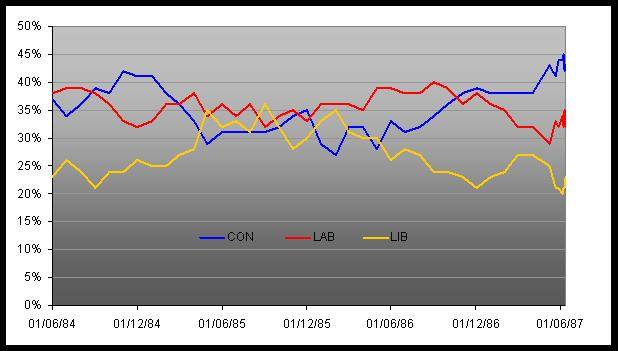
Looking back over the polls between Labour's disastrous 1983 election and resounding defeat in 1987 shows a similar pattern. A year after the election Labour were consistently ahead of the Tories but the failure of the party to earn the trust of voters saw this gradually eroded by the 1987 election day. The same thing happened again between 1987 and 1992. Until Ed Miliband starts to get a strong and positive recognition from voters I fear that 2015 may lead to a similar result as 1987 or 1992.


It feels a bit like the 1980s at the moment. An unpopular Tory government, cuts, protests and a dodgy economy. Miliband's job is easier than Kinnock's though as there is no major internal party strife to deal with. It is an opportunity and a crucial one for the country at a time when the Tories are getting cockier by the day with Climate Change minster Greg Barker saying the current government's cuts are what "Thatcher could only have dreamed of." That's very different to the official line and faux sombre faces of George Osborne and Danny Alexander every time they announce more cuts - this is sad and bad but necessary. Miliband needs to make people realise his feelings are real.