With YouGov reporting that Labour is now 14% ahead of the Tories in its latest opinion poll it would be tempting for Labourites to get carried away thinking of victory in a 2015 general election. It might also be tempting to note that Labour is now ahead on "handling the economy". Tempting too to note that Ed Miliband now has better, or least worst, personal ratings that David Cameron.
Of course as "they" say, it is a Snickers not a sprint and the real test will come in three years time. At the moment though it shows that Labour is starting to reap the reward of not being the Tories or the Lib Dems. What matters for Labour is if this is the start of a longer term trend. If so it looks promising though I'd still warn that it is insufficient to expect to win by hoping that the other side mess up. It isn't enough. That will only lead to either defeat or another hung parliament.
Some things have changed recently. Miliband is performing with more confidence. His media appearances are more frequent and more assured. The real test will be whether people start to give him credit for making the right (and popular) call on the key issues as they arise. He has done so without credit on bank bonuses and phone hacking. If he can close that gap and build a coherent and appealing alternative Labour stands a good chance.
YouGov's expert Peter Kellner speculates that the Tories are still the likely winners of the next election, though the prospects of that happening could diminish if the coalition continues to struggle.
That the outcome and both political and economic landscape are so unclear makes predictions almost irrelevant as so much will change in the next three years. Will that also include our leaders?
Showing posts with label ed miliband. Show all posts
Showing posts with label ed miliband. Show all posts
Tuesday, May 15, 2012


Wednesday, February 29, 2012
Will 2015 follow 2010 and be a loser's election?
As we head towards the mid point of the current parliament no party looks like being the next victor. On current form a 2015 general election will bring results much like 2010l, where there was no clear winner.
In 2010 Gordon Brown had failed to convince the country he deserved to win. David Cameron assumed his Tories would waltz to power by default, yet they didn't. The Lib Dems lost numerous seats as they failed to take advantage of Nick Clegg's popularity bounce following the TV debates.

In 2012 we've got a Labour leader in Ed Miliband who is growing into his role but hasn't convinced yet. Depending on who you ask, his leadership is either a work in progress or ineffective. The Tories are struggling to get their programme through parliament, such as NHS reforms, in the face of huge public and professional opposition. While many voters buy their line that the economy is "Labour's mess" they are not convinced that the Tories are the best for the country. The Lib Dems are paying the price for fronting up several of the Tories unpopular policies, such as the trebling of tuition fees.
How does that project the three parties forward to 2015?
Labour need to continue to build on successes, such as forging the political agenda, as they did over phone hacking and bankers' bonuses, but through to actual cut through with voters. This has so far failed to materialise. The Telegraph's Benedict Brogan is right when he says "Labour would be foolish to think an absence of enthusiasm for the Tories can get it out of its strategic hole". It can't win by default, just as it failed to do in the 1980s.
The Tories need voters to start thanking them for taking tough but correct action to improve the economy. They also need to look more like a government in control of events and the political agenda than they currently do. They need to look like they are most fit to govern of the three parties.
The Lib Dems need people to forget about their sins, such as trebling tuition fees and hope to recover local support where their pockets of seats exist. I have no idea whether this will happen.
Nobody looks like doing what they need to forge ahead in the polls. That means it is all up for grabs and the political landscape is likely to continue to shift according to external events and how each of the main players react to this.
In 2010 Gordon Brown had failed to convince the country he deserved to win. David Cameron assumed his Tories would waltz to power by default, yet they didn't. The Lib Dems lost numerous seats as they failed to take advantage of Nick Clegg's popularity bounce following the TV debates.

In 2012 we've got a Labour leader in Ed Miliband who is growing into his role but hasn't convinced yet. Depending on who you ask, his leadership is either a work in progress or ineffective. The Tories are struggling to get their programme through parliament, such as NHS reforms, in the face of huge public and professional opposition. While many voters buy their line that the economy is "Labour's mess" they are not convinced that the Tories are the best for the country. The Lib Dems are paying the price for fronting up several of the Tories unpopular policies, such as the trebling of tuition fees.
How does that project the three parties forward to 2015?
Labour need to continue to build on successes, such as forging the political agenda, as they did over phone hacking and bankers' bonuses, but through to actual cut through with voters. This has so far failed to materialise. The Telegraph's Benedict Brogan is right when he says "Labour would be foolish to think an absence of enthusiasm for the Tories can get it out of its strategic hole". It can't win by default, just as it failed to do in the 1980s.
The Tories need voters to start thanking them for taking tough but correct action to improve the economy. They also need to look more like a government in control of events and the political agenda than they currently do. They need to look like they are most fit to govern of the three parties.
The Lib Dems need people to forget about their sins, such as trebling tuition fees and hope to recover local support where their pockets of seats exist. I have no idea whether this will happen.
Nobody looks like doing what they need to forge ahead in the polls. That means it is all up for grabs and the political landscape is likely to continue to shift according to external events and how each of the main players react to this.
Thursday, February 02, 2012
David versus Ed Miliband in social media
I wanted to see if David Miliband's New Statesman article and widespread news coverage of it had led to much social media commentary.
It clearly has, shown in the chart below detailing the number of mentions for each of the Miliband brothers over the last month:
 This shows how mainstream news agenda is still driving social media and political commentary. Obviously. I'll keep an eye on how long the David bubble continues to fly.
It clearly has, shown in the chart below detailing the number of mentions for each of the Miliband brothers over the last month:

David, Ed and the media
David Miliband's New Statesman article has garnered a great deal of media attention today. Everyone is either looking for, finding or creating signs of disagreement and tension between the elder Miliband and his brother, Ed, who beat him to the Labour leadership.
David's article is thoughtful and written with an academic style. The sentiment of this morning's media splashes has been wildly different. They have predictably focused on the fireworks rather than the proactive suggestions he makes because it makes for a much better story.


Is David really calling for a total re-think of his brother's stewardship of Labour? Does it matter? What does this tell us about Labour at the moment and the media's response to it?
David actually says what a host of Labour people said in the Purple Book recently, that the party needs to be state reformers and look beyond a big state as the answer to problems. He also stresses the need to balance internationalism, growth, investment and equal opportunities to help create an improving and thriving economy. It is hard to argue with any of this.
The perception gap with his brother isn't there in his words.
The perception gap between David and Ed's vision is in the words of the journalists who have reported on this. I don't see a great deal of difference between what the two brothers are either saying or putting into Labour policy. His key statement isn't all that different from what the Eds have been trying to get across to a sceptical media and voters:
"Our attacks on the Tories will not work if we are not clear about what we did. We should say loud and clear where we made mistakes, but we should also insist that the list of gains far outstripped the mistakes. After all, even David Cameron said on coming to office that Britain was better in 2010 than 1997."
He goes on:
"Principle without power is the stuff of a debating society, not a political party. "
David's article is thoughtful and written with an academic style. The sentiment of this morning's media splashes has been wildly different. They have predictably focused on the fireworks rather than the proactive suggestions he makes because it makes for a much better story.


David actually says what a host of Labour people said in the Purple Book recently, that the party needs to be state reformers and look beyond a big state as the answer to problems. He also stresses the need to balance internationalism, growth, investment and equal opportunities to help create an improving and thriving economy. It is hard to argue with any of this.
The perception gap with his brother isn't there in his words.
The perception gap between David and Ed's vision is in the words of the journalists who have reported on this. I don't see a great deal of difference between what the two brothers are either saying or putting into Labour policy. His key statement isn't all that different from what the Eds have been trying to get across to a sceptical media and voters:
"Our attacks on the Tories will not work if we are not clear about what we did. We should say loud and clear where we made mistakes, but we should also insist that the list of gains far outstripped the mistakes. After all, even David Cameron said on coming to office that Britain was better in 2010 than 1997."
He goes on:
"Principle without power is the stuff of a debating society, not a political party. "
The problem is that many commentators long ago decided that Ed's solutions are of the former, not the latter and haven't bothered to look at the detail because it gets in the way of a good story. David's ideas should be a hand up not a slap in the face for his brother. I think most within the Labour Party will see it that way, but that won't make a good story.
Monday, January 30, 2012
Ed Miliband gets it right again
Ed Miliband's lobbying for a parliamentary vote about the size of state owned RBS boss Stephen Hester's bonus led to the banker backing down and waiving his bonus. Even the BBC's Robert Peston admitted it was Miliband's campaigning that forced the issue.

This is great news for Miliband and Labour as it shows that the he has again forced the political agenda and made the right call on a high profile issue. His response to phone hacking is another key example.
Unfortunately Miliband's right calls on the issues that matter have done nothing to boost his or Labour's opinion poll ratings, with the Tories on a poll high. What will it take for Miliband to cement himself as the man who calls it right in the mind of the voting masses?

This is great news for Miliband and Labour as it shows that the he has again forced the political agenda and made the right call on a high profile issue. His response to phone hacking is another key example.
Unfortunately Miliband's right calls on the issues that matter have done nothing to boost his or Labour's opinion poll ratings, with the Tories on a poll high. What will it take for Miliband to cement himself as the man who calls it right in the mind of the voting masses?
Tuesday, January 17, 2012
Ed Miliband and the unions
Ed Miliband today came in for criticism from trade union leaders for backing Shadow Chancellor Ed Balls who said Labour cannot promise to reverse all Tory cuts if it got in power again. This seem like such an obvious point from Balls and Miliband that I find it quite absurd that he has come in for today's flak.
It is in no way a betrayal of ordinary people or an acceptance that the Tories are right. It is just sensible real-politik.
The unions will simply alienate people from Labour by attempting to pull Miliband's puppet strings so publicly.
Of course, this is a problem for Miliband for he so openly used the unions to get the Labour leadership in the first place. What happens next will be interesting to see if Miliband has the balls to stand up to them or if the unions call in their favours.
- Posted using BlogPress from my iPhone
It is in no way a betrayal of ordinary people or an acceptance that the Tories are right. It is just sensible real-politik.
The unions will simply alienate people from Labour by attempting to pull Miliband's puppet strings so publicly.
Of course, this is a problem for Miliband for he so openly used the unions to get the Labour leadership in the first place. What happens next will be interesting to see if Miliband has the balls to stand up to them or if the unions call in their favours.
- Posted using BlogPress from my iPhone
Tuesday, January 10, 2012
Will Ed Miliband make a difference?
Ed Miliband's speech today suggesting that Labour can't rely on splashing the cash if in government again picked up from recent articles and posts by the likes of Peter Watt and Gavin Kelly. The latter two were as criticising Miliband, despite his likely agreement with them.
Ed Balls and Miliband have been trying to get across the argument that growth should be used to cut the deficit. Today was the first time I've seen Miliband explain this in simple language, that you need people working and paying taxes to pay off the deficit, not claiming benefits. This is promising though the problem with Miliband's leadership has rarely been about what he has said, which is getting better all the time, more about two things:
Ed Balls and Miliband have been trying to get across the argument that growth should be used to cut the deficit. Today was the first time I've seen Miliband explain this in simple language, that you need people working and paying taxes to pay off the deficit, not claiming benefits. This is promising though the problem with Miliband's leadership has rarely been about what he has said, which is getting better all the time, more about two things:
- Perception
- Clear alternative
Miliband's perception problem hasn't gone away. His personal poll ratings are very bad at the moment though he is getting much more media coverage. Having a clear alternative set of policies to the government isn't easy but will become very necessary. There were a smattering of new proposals today though nothing fundamental. His theme of the "squeezed middle" has stuck with both Tories and Lib Dems trying to steal parts of his rhetoric. He proposes to promote changed business practice, like an end to quarterly reporting, to develop a long term investment based capitalism.
Aside from his personal perception problems, Miliband faces difficulty in persuading voters that he understands the severity of the government deficit and knows how to get rid of it without unnecessarily and adversely affecting their way of life. He hasn't done that yet, people are just not believing Labour at the moment.
Balls and Miliband have to convince people other than me that they should be taken seriously on the deficit and the economy. It hasn't worked so far, today's speech won't change it overnight either. At the moment it is all too esay to attack them for being involved in the last Labour government and to stop listening. There is some great stuff in the detail but most people don't bother with that. Not least when a hostile media doesn't tell them.
Tuesday, July 12, 2011
Will Miliband pay for his attacks on Murdoch?
He is playing a dangerous game, one that put paid to Neil Kinnock's chances of being PM almost 20 years ago. If Murdoch is fundamentally weakened then Miliband will get away with it. If his power remains he could find himself up against an insurmountable barrier of opposition from Murdoch.
Even before hackgate really kicked off in the last few weeks, is the Murdoch media empire as powerful as it once was? Politicians clearly think so. Given that Murdoch will continue to control a significant level of British media, across the newspaper titles, Sky News and BSkyB. He still matters whether we like it or not. Many of the British public might not like the hacking of murder victims' phones or the Queen's private details but I don't expect them to stop buying Murdoch products.
Miliband has grown during this crisis. He has been saying the right things and doing so with more gravitas. The media has also been keen to give him prominence. It is going to be interesting to see whether this translates into improved personal poll ratings for him as this impact has been lacking so far.
Miliband's future success depends largely on how strongly the government come down on media owners. Their presumption is to step away, which is being challenged by recent events. If the Tories revert to type as the brouhaha dies down it will strengthen their own position by strengthening Murdoch and knocking Miliband.
These are interesting times in British politics. The goalposts are shifting every time I look at the news. Will they shift enough to force the Tories to limit the size of a media market owned by one person? I'm not sure they will, which puts Miliband in a vulnerable position.
None of this will be worked out for some time. There are clearly more revelations to come, especially about how much David Cameron knew about Andy Coulson's involvement, about severe corruption in the police and about more people who were compromised by News International. Enquiries and police investigations will all take time too. Projecting forward I would not be surprised if this was still rumbling on in two years time or more . Just as we head towards another general election.
Will anybody care then who The Sun backs? Cameron will, Miliband has already shown he doesn't.
Even before hackgate really kicked off in the last few weeks, is the Murdoch media empire as powerful as it once was? Politicians clearly think so. Given that Murdoch will continue to control a significant level of British media, across the newspaper titles, Sky News and BSkyB. He still matters whether we like it or not. Many of the British public might not like the hacking of murder victims' phones or the Queen's private details but I don't expect them to stop buying Murdoch products.
Miliband has grown during this crisis. He has been saying the right things and doing so with more gravitas. The media has also been keen to give him prominence. It is going to be interesting to see whether this translates into improved personal poll ratings for him as this impact has been lacking so far.
Miliband's future success depends largely on how strongly the government come down on media owners. Their presumption is to step away, which is being challenged by recent events. If the Tories revert to type as the brouhaha dies down it will strengthen their own position by strengthening Murdoch and knocking Miliband.
These are interesting times in British politics. The goalposts are shifting every time I look at the news. Will they shift enough to force the Tories to limit the size of a media market owned by one person? I'm not sure they will, which puts Miliband in a vulnerable position.
None of this will be worked out for some time. There are clearly more revelations to come, especially about how much David Cameron knew about Andy Coulson's involvement, about severe corruption in the police and about more people who were compromised by News International. Enquiries and police investigations will all take time too. Projecting forward I would not be surprised if this was still rumbling on in two years time or more . Just as we head towards another general election.
Will anybody care then who The Sun backs? Cameron will, Miliband has already shown he doesn't.
Tuesday, June 21, 2011
Mandelson meddling again?
Peter Mandelson's speech to Progress yesterday was a predictable, right and honest appraisal of the Labour Party's current predicament.
It isn't news that Labour needs to make a bigger impact on voters after a natural period of reflection following defeat a year ago. It isn't news that Labour is skint either, but how exactly the party is going to fund itself is a rather large, unaswered question. At the moment the reliance on trade union funding is stark and quite worrying. A return to the days of big business donations is also unlikely as a party of opposition is far less attractive a proposition.
His lesson is that what Labour learnt in the 1980s and 1990s - that it must focus on appealing to voters first and last is as true today. That is why the real lesson of New Labour, which is about having an honest centre left appeal to people that is based on an understanding of what people actually want, stands as true today as it did in 1994.
Personalities may change but the principle should remain exactly the same.
Changes do need to be made to the wording. Party structure and policies need to change to reflect that we are not in 1994, 1997 or 2005 any more. The game has changed and will have done so further after at least five years of Tory destruction. The relationship between state and individual will be completely different in 2015 to the one Labour left behind.
As Ed Miliband said in one of his first speeches as leader, we need to be the optimists. Labour need to show the country that we can improve public services and offer better value for money. We also need to stand up for services that improve people's lives, protect the environment, enhance opportunity and create opportunities for business. The Tories are pessimists who don't believe it is even worth trying to achieve many of these goals. Labour needs to show that things can be different.
Mandelson's speech demonstrates there is a lot of work to be done to get Labour into a winning position again. He also shows that by sticking to the principles that made the party so successful not that long ago, it doesn't have to be that difficult.
It isn't news that Labour needs to make a bigger impact on voters after a natural period of reflection following defeat a year ago. It isn't news that Labour is skint either, but how exactly the party is going to fund itself is a rather large, unaswered question. At the moment the reliance on trade union funding is stark and quite worrying. A return to the days of big business donations is also unlikely as a party of opposition is far less attractive a proposition.
His lesson is that what Labour learnt in the 1980s and 1990s - that it must focus on appealing to voters first and last is as true today. That is why the real lesson of New Labour, which is about having an honest centre left appeal to people that is based on an understanding of what people actually want, stands as true today as it did in 1994.
Personalities may change but the principle should remain exactly the same.
Changes do need to be made to the wording. Party structure and policies need to change to reflect that we are not in 1994, 1997 or 2005 any more. The game has changed and will have done so further after at least five years of Tory destruction. The relationship between state and individual will be completely different in 2015 to the one Labour left behind.
As Ed Miliband said in one of his first speeches as leader, we need to be the optimists. Labour need to show the country that we can improve public services and offer better value for money. We also need to stand up for services that improve people's lives, protect the environment, enhance opportunity and create opportunities for business. The Tories are pessimists who don't believe it is even worth trying to achieve many of these goals. Labour needs to show that things can be different.
Mandelson's speech demonstrates there is a lot of work to be done to get Labour into a winning position again. He also shows that by sticking to the principles that made the party so successful not that long ago, it doesn't have to be that difficult.
Friday, June 17, 2011
A poor week for all the parties
It is popular to remark that the Tories are undergoing a series of policy and political retreats. It is also popular to opine that this is a result of the Lib Dems restreating to their lefty safe territory after their local election wipe out.
Some of this is true. We wouldn't have had the NHS reform listening exercise or the changes to the programme if there wasn't something different about it. The real difference isn't in the policy changes that may or may not happen, I expect wholesale changes to the NHS to happen anyway.
What this all demonstrates is that the Tories feel politically weak. They are allowing both the Lib Dems and the risk of unpopularity with the electorate to force their hand. The Tories should feel stronger than they do because even if the Lib Dems want to flex their muscles, they too are week and facing oblivion.
The Tories know that the NHS is an historic weakness. People don't trust them with it so they can't take the risk losing whatever credibility they have with the health service. This also demonstrates political naiivity. Properly researched and planned before being announced, these changes could have met the needs of the health service in the first place and avoided talk of u-turns and retreats. This suggests that in the quest for taking power the coalition partners didn't work their way through all the detail. If the Lib Dems really were so opposed to all of this why didn't they say so when they had real power - at the coalition negoatiation phase.
This will be presented as a Lib Dem victory. The danger is that this will appeal to some of the Lib Dems lost voters but will further antagonise their coalition partners and masters, the Tories.
Nick Clegg needs to be very careful, while Cameron has more political strength than he realises. Ed Miliband should do everything to exploit a Clegg clinging on for life and a Cameron who is weak and reactiving the poltical environment rather than shaping it.
Some of this is true. We wouldn't have had the NHS reform listening exercise or the changes to the programme if there wasn't something different about it. The real difference isn't in the policy changes that may or may not happen, I expect wholesale changes to the NHS to happen anyway.
What this all demonstrates is that the Tories feel politically weak. They are allowing both the Lib Dems and the risk of unpopularity with the electorate to force their hand. The Tories should feel stronger than they do because even if the Lib Dems want to flex their muscles, they too are week and facing oblivion.
The Tories know that the NHS is an historic weakness. People don't trust them with it so they can't take the risk losing whatever credibility they have with the health service. This also demonstrates political naiivity. Properly researched and planned before being announced, these changes could have met the needs of the health service in the first place and avoided talk of u-turns and retreats. This suggests that in the quest for taking power the coalition partners didn't work their way through all the detail. If the Lib Dems really were so opposed to all of this why didn't they say so when they had real power - at the coalition negoatiation phase.
This will be presented as a Lib Dem victory. The danger is that this will appeal to some of the Lib Dems lost voters but will further antagonise their coalition partners and masters, the Tories.
Nick Clegg needs to be very careful, while Cameron has more political strength than he realises. Ed Miliband should do everything to exploit a Clegg clinging on for life and a Cameron who is weak and reactiving the poltical environment rather than shaping it.
Monday, June 13, 2011
Where now for Ed?
It is too early to properly judge Ed Miliband’s leadership of the Labour Party after only eight months. He still has time to prove his doubters wrong because there won’t be another general election for four years. Unfortunately the minds of many in the party and media have already been made up. Ed was on the back foot from the moment he was elected. First he had to defend himself from the “Red Ed” tags and has since been fending off a succession of polls that show he hasn’t yet convinced voters to back him.
Given that he hasn’t made the most convincing start but still has time, how can Ed show people he really is leadership material? He needs to have a plan for the country and needs to communicate that. His vision must be clear and show that he understands that the country doesn’t want a lurch to the left but does want Labour to offer them protection against the rising cost of living and understands their concerns about crime and immigration.
The plan needs to come quickly to enable Ed to gain positive momentum in time for party conference in September. He has to convince a sceptical party he can get them back into government. Will he? I hope so, though that depends on whether he gives himself the chance.
Wednesday, June 08, 2011
Can Ed Miliband succeed where Tony Blair failed?
The Labour Party has surveyed voters' views as part of the major policy review. This has shown that voters want Labour to be strong on immigration, protect British interests first in Europe and international affairs, propose welfare reform and be tough on crime. This sounds remarkably like Tony Blair's rights and responsibilities policy agenda. It should surprise nobody.
This is no surprise because the country moved to the right at the last election. These are issues that are typically hard for Labour to campaign on as the party finds it easier to talk about subjects that matter to lefties. These leftie issues are unlikely to be enough to win Labour an election. However, these are the bread and butter working class issues and Ed Miliband needs to seize control of this agenda.
The Labour survey also showed that voters want the party to be tough on bankers and to soften the market. This is Miliband's natural territory. I don't think he'll find it easy to be talking about crime and immigration but it is an absolute must. That he hasn't yet can in part explain Labour's failure to secure first place in the English local elections.
Miliband's challenge is the tough, classic one faced by all Labour leaders. Talk tough on crime and immigration and lose support of the party and win votes, or do the opposite. If he can find a happy equilibrium he will strike gold.
This is no surprise because the country moved to the right at the last election. These are issues that are typically hard for Labour to campaign on as the party finds it easier to talk about subjects that matter to lefties. These leftie issues are unlikely to be enough to win Labour an election. However, these are the bread and butter working class issues and Ed Miliband needs to seize control of this agenda.
The Labour survey also showed that voters want the party to be tough on bankers and to soften the market. This is Miliband's natural territory. I don't think he'll find it easy to be talking about crime and immigration but it is an absolute must. That he hasn't yet can in part explain Labour's failure to secure first place in the English local elections.
Miliband's challenge is the tough, classic one faced by all Labour leaders. Talk tough on crime and immigration and lose support of the party and win votes, or do the opposite. If he can find a happy equilibrium he will strike gold.
Tuesday, April 05, 2011
Labour by default
Labour's lead in opinion polls remains consistently at a minimum of five points over the Tories with the Lib Dems around or below 10%.

Looking back over the polls between Labour's disastrous 1983 election and resounding defeat in 1987 shows a similar pattern. A year after the election Labour were consistently ahead of the Tories but the failure of the party to earn the trust of voters saw this gradually eroded by the 1987 election day. The same thing happened again between 1987 and 1992. Until Ed Miliband starts to get a strong and positive recognition from voters I fear that 2015 may lead to a similar result as 1987 or 1992.

It feels a bit like the 1980s at the moment. An unpopular Tory government, cuts, protests and a dodgy economy. Miliband's job is easier than Kinnock's though as there is no major internal party strife to deal with. It is an opportunity and a crucial one for the country at a time when the Tories are getting cockier by the day with Climate Change minster Greg Barker saying the current government's cuts are what "Thatcher could only have dreamed of." That's very different to the official line and faux sombre faces of George Osborne and Danny Alexander every time they announce more cuts - this is sad and bad but necessary. Miliband needs to make people realise his feelings are real.
Looking back over the polls between Labour's disastrous 1983 election and resounding defeat in 1987 shows a similar pattern. A year after the election Labour were consistently ahead of the Tories but the failure of the party to earn the trust of voters saw this gradually eroded by the 1987 election day. The same thing happened again between 1987 and 1992. Until Ed Miliband starts to get a strong and positive recognition from voters I fear that 2015 may lead to a similar result as 1987 or 1992.
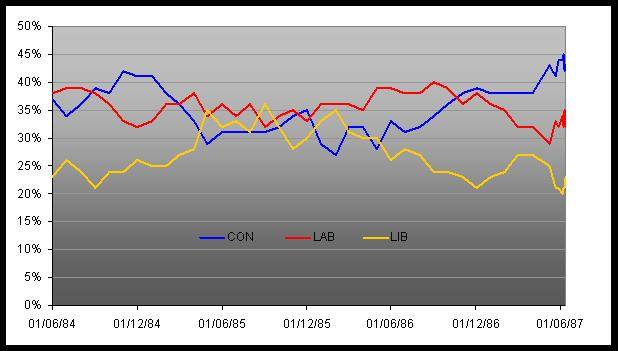
It feels a bit like the 1980s at the moment. An unpopular Tory government, cuts, protests and a dodgy economy. Miliband's job is easier than Kinnock's though as there is no major internal party strife to deal with. It is an opportunity and a crucial one for the country at a time when the Tories are getting cockier by the day with Climate Change minster Greg Barker saying the current government's cuts are what "Thatcher could only have dreamed of." That's very different to the official line and faux sombre faces of George Osborne and Danny Alexander every time they announce more cuts - this is sad and bad but necessary. Miliband needs to make people realise his feelings are real.
Subscribe to:
Posts (Atom)